The Complete Guide to Rent-to-Own Ontario Homes: How It Works, What to Watch For, and How to Do It Safely
Your step-by-step roadmap to becoming a homeowner—without needing perfect credit, 10% down, or closing costs today.
Why Rent-to-Own Matters in Today’s Market
Why does Rent-to-Own Ontario matter today? Mortgage rules keep tightening. Debts keep increasing. As a result, many hardworking families sit on the sidelines—not because they can’t afford a home, but because they can’t satisfy a bank’s criteria today. This is a common challenge today.
That gap between affording a home and qualifying for a mortgage is where Rent-to-Own (RTO) becomes powerful. When done properly, Rent-to-Own helps responsible, high-income earners enter the market now, build equity while they live in the home, and position themselves for mortgage approval in 3–4 years.
The problem?
There’s good Rent-to-Own… and there’s risky Rent-to-Own.
This guide shows you how to tell the difference, how the math works, and how to protect yourself every step of the way.
1. What Rent-to-Own Actually Is (and What It Isn’t)
At its core, Rent-to-Own allows you to:
-
Move into a home you choose based on a budget provided to you
-
Make monthly payments similar to a mortgage
-
Have a portion of those payments go toward your future down payment
-
Lock in the future purchase price
-
Buy the home with your own mortgage at the end of the program
It’s not renting (see a comparison here):
-
A way to “avoid” mortgage rules (stress test still applies)
-
A last-chance option for people with no income or down payment
-
A lease with vague promises
-
A co-ownership program
-
A landlord doing you a favour
Done right, Rent-to-Own is a structured, numbers-driven path to homeownership.
2. Who Rent-to-Own Helps Most
Rent-to-Own works best for people who earn good income and have some savings but are blocked by one of these issues:
Credit challenges
Consumer proposal
Collections
Late payments
High utilization
Thin credit file
Need a bigger down payment
You have 5% saved, but a bank wants 10–15% to keep the mortgage insured.
Have the down payment but not the closing costs
Many first-time buyers don’t have the extra $10,000–$20,000 for land transfer tax and legal fees.
Self-employed
You need two years of strong declared income to qualify—even if your business is thriving.
Recently divorced or separated
Your income may be strong, but your credit and debt may need repairing.
New to Canada
You need time to build the credit history banks want.
Rent-to-Own is not a shortcut. It’s a bridge—one that gives you structure, time, and a clear plan to get mortgage-ready.
3. How Rent-to-Own Works Step-by-Step
Here’s the process, simplified so even a grandmother can explain it:
Step 1 — Get Pre-Qualified
You share:
-
Household income
-
Savings for a down payment (minimum 5%)
-
Your credit snapshot
This determines how much home you can afford and the timeline needed to improve your credit so you can get mortgage-ready.
Quick rule of thumb:
Income × 4.5 + your down payment = a rough home budget.
Step 2 — Choose a Home You Love
You work with a real estate agent, just like any other buyer.
You’re not choosing from “inventory homes.” You should be choosing a home you love and can see your family settling into for the foreseeable future.
Step 3 — The Investor Purchases the Home
A qualified investor (private family) buys the property on your behalf.
You contribute your 5% down.
The investor covers:
-
Closing costs
-
Land transfer tax
-
Legal fees
This is where Rent-to-Own becomes powerful. You move in without needing bank approval or closing costs today.
Step 4 — Move In and Start Building Equity
Your monthly payment is similar to mortgage payment on the same house that you could qualify for.
-
Mortgage component (covers carrying costs like property tax and house insurace) and from each monthly payment, you can build equity of $400-600 each month which is credited back to you from your monthly payment and added to your initial down payment just for paying on time – which you would be required to do anyways.
Every month, you’re building equity as if you already owned the home.
Step 5 — Improve Credit & Pay Down Debt
This is where most buyers need help.
A strong Rent-to-Own program:
-
Gives provides you with a credit improvement plan
-
Connects you with mortgage-savvy professionals
-
Tracks progress
-
Adjusts strategy as your financial situation changes
Banks don’t help you fix your credit.
A structured Rent-to-Own can BUT you have to do the work.
Step 6 — Buy the Home with Your Own Mortgage
At the end of the 3–4 year term:
-
Your down payment has increased
-
Your credit is stronger
-
Your debt is better managed
-
You’ve locked in appreciation
-
You buy the home—100% in your name
No co-ownership.
No shared equity.
No landlord.
You’re the owner.
4. What to Watch Out For: The 3 Biggest Risks (and How to Protect Yourself)
Risk #1 — No Legal Review
Some companies discourage buyers from having a lawyer review the contracts.
Red flag.
Always work with an independent lawyer who understands Rent-to-Own.
Risk #2 — Monthly Payments Higher Than You Can Afford
Rent-to-Own payments are similar to a mortgage payment—not rent.
Protect yourself by:
-
Reviewing a full payment breakdown
-
Comparing it to your current spending
-
Confirming the payment is sustainable for 3–4 years
- Don’t do it if you don’t think you can handle the payments long term. Your personal, monthly budget should trump any budget provided to you. After all, no one knows your payment obligations better than you do.
Risk #3 — No Credit or Budget Support
If no one is monitoring your progress, your chances of mortgage approval drop.
A reputable program gives you:
-
Access to a credible budget specialist who can assist you in fixing your finances to a) put more money towards debt b) savings or c) investments
-
Debt-pay-down strategies
-
Accountability check-ins
-
Access to mortgage specialists who understand Rent-to-Own
Support is what separates successful buyers from those who fall behind.
5. Key Financial Benefits of Rent-to-Own
1. You get into the market sooner
Every year you sit out, prices can rise and the required down payment rises with it.
2. You build equity while you live in the home
You’re not “renting.” You’re buying—over time.
3. You lock in today’s purchase price
Even if the market rises 5–10% per year, your future price is set on day one.
4. You don’t need closing costs today
The investor covers them.
You repay nothing until you buy the home at the end.
5. You gain time to become mortgage-ready
Credit improvement
Debt restructuring
Income stabilization
6. Real Examples: How Rent-to-Own Works in Real Life
Mike & Jessica
Both went through divorces.
Credit dropped.
Income was solid, but banks wouldn’t approve them.
They entered a Rent-to-Own program, stabilized debt, rebuilt credit, and bought their Ajax townhouse with a standard mortgage. Today, they’re homeowners again.
Nadia
A single mom who earned great income but had a recent consumer proposal.
Banks said no.
She had 5% saved—just not enough.
Rent-to-Own gave her time to rebuild her credit and get into the home she wanted for her kids.
Rachel’s Parents
Immigrants. Hard-working. Always renting.
By the time they were ready to buy, the market had outrun them—and mortgage rules were far tougher.
That experience sparked a mission:
No one should be priced out of homeownership simply because the bank said “not yet.”
7. How to Know If Rent-to-Own Is Right for You
It’s a good fit if:
-
You earn $100K–$200K household income
-
You have $25K–$50K saved
-
You can comfortably handle a payment similar to a mortgage
-
You want stability and long-term ownership
-
You prefer a structured plan
-
You’re coachable and serious and have a homeowners mindset
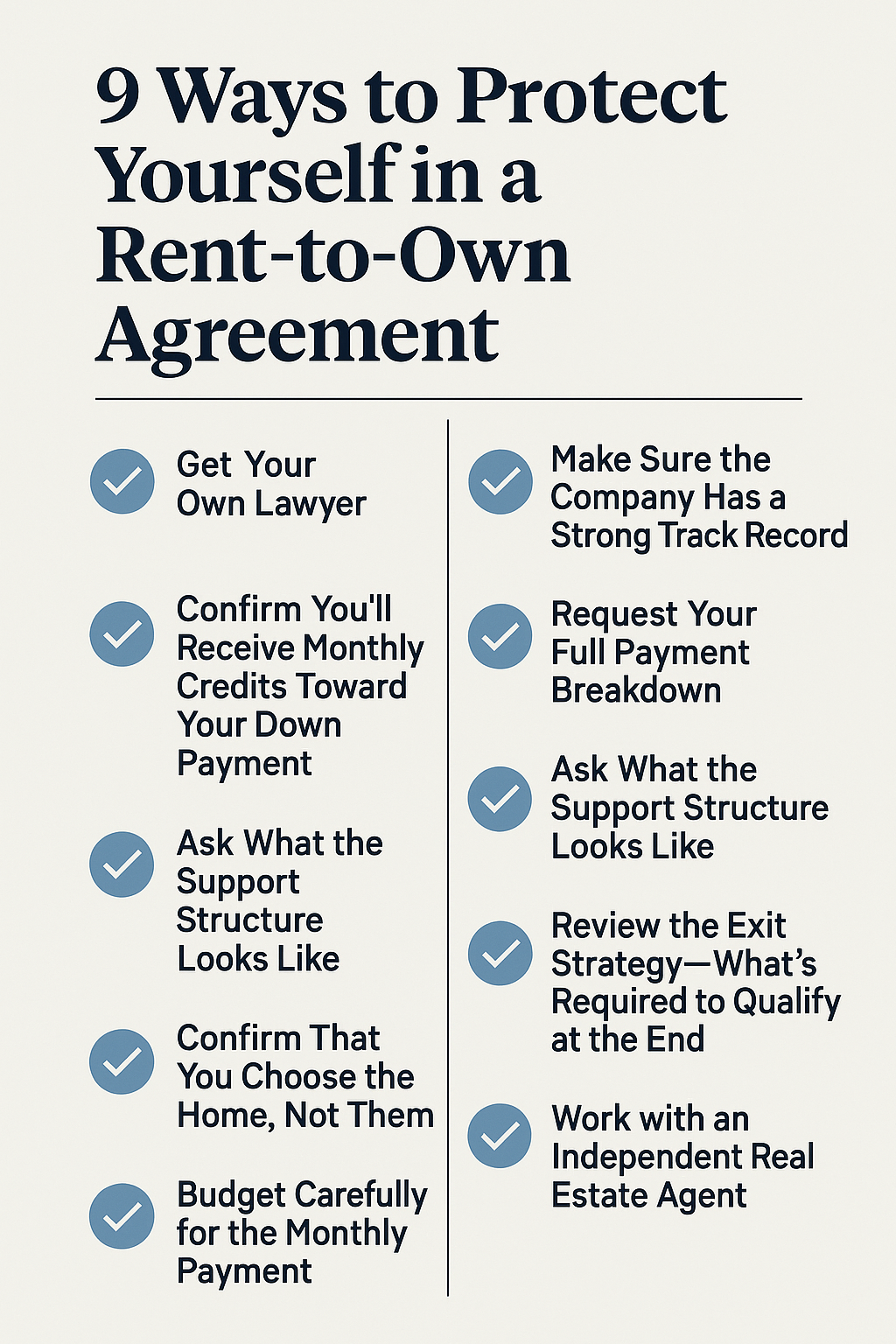
8. How to Protect Yourself (Non-Negotiables)
✓ Get your own lawyer
✓ Make sure the company has a strong track record
✓ Confirm you’ll receive monthly credits toward your down payment
✓ Request your full payment breakdown (budget call)
✓ Ask what the support structure looks like
✓ Review the exit strategy—what’s required to qualify at the end
✓ Confirm that you choose the home, not them
If any of these feel vague, incomplete, or rushed—walk away.
9. Your Next Step: Find Out What You Can Afford
This is where most buyers get clarity.
You’ll learn:
-
How much home you could afford now
-
What your monthly payment would look like
-
Whether Rent-to-Own is the right fit for your situation
-
What timeline makes the most sense for mortgage approval
The conversation is simple, pressure-free, and designed to give you answers—not push you.
Want to Find Out If You Can Own a Home Sooner Than You Think?
Book your Homeowner Planning Call with an RTO Specialist.
You bring your income and down payment.
We show you a clear path.
You decide if this is your moment to start owning instead of renting.
Rent-to-Own Ontario Complete Guide